
Project Highlights:
- Endridge Gas
- Headquartered in Calgary, Alberta, Canada
- Supplies natural gas to over 1 million customers in Utah, Wyoming and Idaho
- Owns and operates the world’s longest crude oil and liquids pipeline system
- Operates over 457,000 kilometres of oil and gas pipelines and service lines
Enbridge Gas (Enbridge), formerly Dominion Energy, supplies natural gas to more than one million customers across Utah, Wyoming and Idaho through its intermediate- to high-pressure gas distribution network (IGIS) and high-pressure transmission feeder network (HGIS). Historically, the transmission and distribution networks were managed in separate databases using Esri’s Geometric Network and the Pipeline Open Data Standard (PODS), respectively.
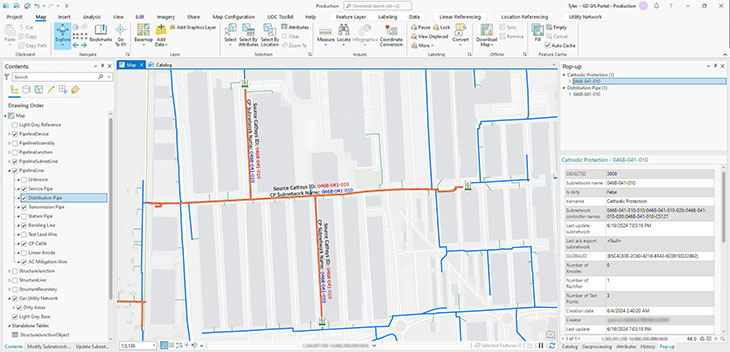
The implementation of Esri’s Network Information Management System provided an opportunity to consolidate the IGIS and HGIS databases into a single Utility and Pipeline Data Model (UPDM) based on ArcGIS Utility Network, with ArcGIS Pipeline Referencing (APR) supporting the transmission network. The resulting enterprise platform enables more efficient management of natural gas network operations through advanced tracing, network analysis and reporting capabilities that support pipeline integrity and safety management.
Two vs. One Asset Database
Previously, Enbridge maintained separate transmission and distribution network models, with limited connectivity between regulator stations. This prevented users from tracing natural gas flow from gate stations through to customer meters and restricted tracing capabilities within the transmission network.
The programme aimed to improve data quality, enhance GIS editing workflows, streamline operational processes, strengthen enterprise system integration and improve support for pipeline safety and regulatory compliance reporting.
Migration and Model Merger
Working in partnership with UDC, Enbridge successfully managed the migration and configuration of its enterprise GIS using UDC’s HEIDE migration solution. An automated, iterative migration approach reduced project risk while validating data quality throughout the implementation.
The project began with a readiness assessment to identify any gaps between standard Utility Network functionality and Enbridge’s operational workflows. Prototype applications were then developed to validate business processes before implementation.
The solution incorporated four subnetwork tiers:
- System
- Pressure
- Cathodic Protection
- Isolation
Data migration and data cleansing were completed using automation together with UDC’s custom migration toolkit across four iterative test migrations.
UDC also enhanced integrations between the GIS and several enterprise systems, including customer information, work management, Department of Transportation (DOT) compliance and rights-of-way (ROW) management systems. ArcGIS Workflow Manager was implemented to support GIS editing processes across both transmission and distribution operations.
To maintain existing business processes while introducing new Utility Network capabilities, UDC developed a range of bespoke tools and automation scripts. These included automated posting of versioned edits to the default version, scheduled overnight subnetwork updates and a Linear Referencing System (LRS) hierarchy to support network risk assessment.
Existing tools were also rebuilt or modernised, including applications supporting rate case analysis, business district management, dynamic segmentation for reporting and GPS-based mapping.
Combined Model Benefits
The project brought Enbridge’s natural gas transmission and distribution assets together within a single network information management platform, providing a comprehensive enterprise-wide view of gas operations and improved visibility of regulatory compliance activities.
Migrating to a connected Utility Network data model also eliminated significant duplication of service information while introducing standardised data structures and validation rules. The resulting subnetwork architecture enables consistent network tracing, analysis and automated reporting from a single source of truth, supporting more efficient pipeline maintenance, operational planning and safety management.
“Utility Network provides a stable platform that will support opportunities to configure business-specific applications, reports and maps,” said Matt Bartol, PE, general manager of gas operations at Enbridge Gas. “Getting maps and data into the hands of our teams will empower them to make data-driven decisions to operate more safely, reliably and efficiently.”
Following the successful implementation, Enbridge intends to share lessons learned and best practices with other business units undertaking Utility Network modernisation initiatives. The organisation also expects that adopting a common enterprise data model across the business will support greater standardisation of reporting, improve operational consistency and create efficiencies through shared tools, workflows and implementation methodologies.
“The benefits of having one model that can incorporate both our transmission and distribution gas assets will be a great advantage for our team and help increase our efficiencies in how we manage the data.”
Jeff Hansen, Director, GIS and Pipeline Safety Management Systems, Enbridge Gas